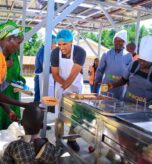



This blog highlights some of the issues that emerged and lessons learned during the Pika na Power Academy. To date, Pika na Power has focused its activities in Nairobi. The recent establishment of the County eCooking Hubs has shown that there is potential for eCooking in many parts of the country. However, as eCooking is a new technology for many people, there is a need to build capacity at the local level to translate this potential into impact on the ground. Local champions have a key role to play in creating awareness, building supply chains and developing business models that are tailored to the local context. The Pika na Power Academy aimed to offer aspiring eCooking champions the skills and experience they need to turn ideas into viable business opportunities that can accelerate the uptake of eCooking across the country.
By Emily Bolo & Leonard Nyongesa
Introduction

E-cooking in Kenya is a relatively new concept and a choice that many households are less familiar with when compared to traditional cooking technologies and fuels. When the campaign about e-cooking began some four years back in Kenya, it was not well received. It appeared to be unrealistic and issues such as unreliable electricity, affordability, and supply issues were pointed out to be the main barriers to the adoption of the technology. Currently, the total installed power in Kenya is 3.3GW while only 2.2GW is utilized.
Despite the surplus in electricity generation, 42.16 million Kenyans still lack access to clean cooking technologies, a figure that could be reduced if e-cooking is adopted. Though approximately 3% of Kenyans own electric cooking appliances, only less than 1% use them to cook as their main source of cooking fuel. The participants of the Pika na Power Academy were, therefore, challenged by the Director Institute of Energy Studies & Research, Dr. Jeremiah Kiplagat, to develop scalable business models that can enable the Kenyan population primarily using electricity to cook increases from 2% to 5% by the end of the year.
The Pika na Power Academy was delivered as a week-long residential course at KPLC’s Institute for Energy Studies and Research (IESR). The curriculum included a diverse array of subjects, including consumer financing; business models & business plan development; testing methods; live cooking demos; energy/power basics; eRecipes & eCookBooks; overview of major appliance categories; energy-saving mechanisms; international supplier negotiation and importation procedures; after-sales service; repair/maintenance; household wiring assessments/upgrades; impact stories; business plan development; stakeholder engagement; marketing strategies; and kitchen energy audits. The programme also included time for networking and peer-to-peer engagement, with the aim of creating a cohort of champions who are able to support each other to develop viable enterprises that can scale the adoption of eCooking across the country.
Factors Affecting the Adoption and Use of Electric Cooking Appliances

This section gives an overview of some of the major challenges that last-mile entrepreneurs face when marketing eCooking appliances. Affordability and awareness aretwo major factors influencing the ability of consumers to purchase electric cooking appliances.-
Affordability is also a major constraint that is hindering the adoption of clean cookstoves and more modern cooking devices such as energy-efficient eCooking appliances. For those who may have the ability to buy, they may not be willing to do so until convinced of the value it will add to their kitchen. To address the problem of affordability, various consumer financing models have been invented. Besides, subsidies can also be used to improve the affordability of e-cooking appliances.
The e-cooking production and supply systems are underdeveloped and its market is fragile and at the nascent stages. Besides, most consumers are not aware of the benefits of the technology and may be inclined to think that it cannot meet all their culture-specific cooking needs. Therefore, the supply and demand factors, if well developed, may play a key role in moving the technology to an established energy service from an emerging one. Reliability of supply is crucial as it will influence demand and guarantee the adoption and sustained use of electric appliances. In the early stages of the electric cooking market, appliance shortage is usually common and it qualifies as a major market disruptor. Constraints in the supply chain are often due to inadequate policies needed to stimulate and sustain noticeable development. Considering that at the moment Kenya cannot produce energy-efficient electric cooking appliances and may have to rely on importation, fluctuations in prices, inflation of local currency, and foreign exchange currency shortages may impact the supply of the products. Consequently, subsidies, financing programs, and structures that influence affordability and availability are key.
After-sale service is also another critical element that ensures the satisfaction and retention of customers. Apart from Sayona distributors, many EPC importers do not have the option of additional inner pots despite continuous requests from consumers. The non-stick coating tends to wear out easily and an extra pot can make it convenient to cook several dishes. Likewise, the appliances become obsolete if spare parts cannot be found to replace damaged ones.
Subsidy Allocation
The biggest players in the clean cooking market tend to get the biggest subsidies and, therefore, greatly influence the market dynamics. Such subsidies enable them to sell their products/services at prices below the market value, which acts as a threat to other small actors within the sector. It is anticipated that carbon financing will intensify the problem since only a few established businesses may benefit from it. Though a good initiative, subsidies tend to influence competition and business by distorting the playing field which changes market signals and alters prices. Despite such challenges, subsidies are rarely subjected to vigorous scrutiny by governments throughout the world. However, they are mostly evaluated or regulated through multilateral laws and free trade agreements.
Solar E-Cooking
Solar Electric cooking has gained a lot of interest from off-grid households after Village Infrastructure Angels Ltd (VIA) conducted a controlled kitchen cooking test pilot study of about 20 off-grid households. The study was conducted in partnership with Strathmore University and Kijani Testing. This is also an area that gained traction from Pika na Power participants based on whether it can operate on both AC and DC power sources, its performance during erratic weather conditions, the possibility of an institutional solar-e-cooker, and pricing.
Despite the greatest opportunity to tap from free solar energy to ensure that no one is left behind as campaigns on on-grid e-cooking intensify, the upfront cost of owning the system is still a big challenge. Secondly, solar e-cooking is still a new technology with the available companies either at the prototyping stage or initial deployment stage. A handful of organizations like VIA and E-Coca East Africa are trying to make this successful, however, being small and with unpopular technology, attracting investors to support mass production is a big challenge. Responding to this challenge, Emily Bolo from ARIN urged the participants and e-cooking entrepreneurs ‘to come together for a greater cause, with collective effort a bigger impact can be achieved for investors to see the need to invest in our projects.’
Star ratings on Electric Appliances
Most electric appliances have star-rating stickers. The star rating is used to guide customers on the efficiency of appliances. The more stars an appliance has from EPRA stickers the more efficient it is. Though its initial purchase may be expensive, the return on investment on the energy consumed will be worthwhile. However, most customers are not familiar with what the ratings mean. This was evident during the Pika na Power training, as participants acknowledged hearing the information for the first time.
Efforts to create awareness on how consumers can identify more efficient electric/e-cooking appliances should be encouraged. With regards to household wiring, cable size, and brand is very important. Approximately 70% of the cables in the Kenyan market are substandard and may contribute to the high energy bills and thus the need to subcontract licensed electricians from EPRA for the installation of quality cables to ensure people can use eCooking appliances safely.
Formation of an Aggregator Business Association (ELCEAK)

There are last-mile e-cooking entrepreneurs working as community-based organizations (CBOs) and micro-enterprises who are neither recognized nor supported to scale up their businesses. As such, convincing stakeholders or funders to work or collaborate with such small and isolated enterprises is very difficult. Most stakeholders are interested in data that will inform them whether they will invest in an initiative or not. However, such data is either currently unavailable or fragmented. To guarantee that the needed data is available when required, the Pika na Power participants decided to form the Electric Cooking Entrepreneurs Association of Kenya (ELCEAK), a product of the training. The association will work towards:
- Being the point of contact for electric cooking entrepreneurs.
- Getting the right e-cooking information and aggregating relevant data that will give it an added advantage over its competitors in the space.
- Strengthening the last-mile distribution and supply system to ensure the reliability of energy-efficient electric appliances and after-sale services.
- Facilitate effective joint bulk import purchasing of e-cooking appliances for its members.
- Aggregate data for proof of net zero to access the benefits of carbon investment as well as RBF.
The following recommendations can enable the sector to support last-mile entrepreneurs to develop sustatinable eCooking enterprises:
- Subsidies ought not to be solely end-user based to ensure that small businesses in the sector are also growing sustainably.
- The e-cooking strategy should address the subsidy issues presented to ensure that the playing field is leveled up for all players in the market, both big and small.
- Local suppliers should be protected from external players who come in, dominate the market, displace, and kill their business.
- Register and strengthen the Electric Cooking Entrepreneurs of Kenya Association as an aggregator to champion the Last Mile market distribution of e-cooking appliances away from the normal super-market stocking.